
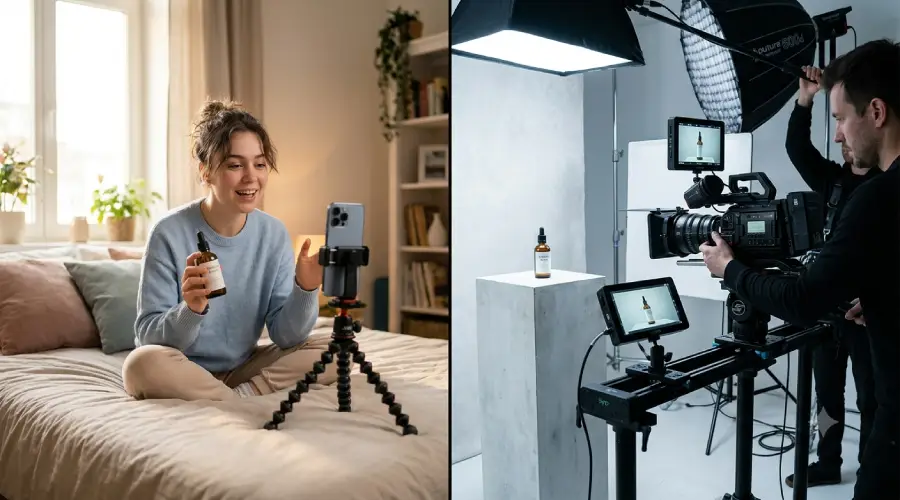
UGC vs professional video ads – the question of which format drives more sales comes up in almost every brand conversation, and the answer depends on the platform, the product, the funnel stage, and what the brand is trying to accomplish. The sections below cover how each format performs, where each wins, and why the brands seeing the best results are combining both. AD.JUST Video Production has produced both UGC-style video ads and fully produced professional campaigns for e-commerce brands, DTC companies, and Amazon sellers across TikTok, Meta, Instagram, and Amazon.
What Each Format Actually Means
Before comparing performance, it helps to be precise about what each format is.
A UGC (user-generated content) video ad is content designed to look like it was created by a real customer or creator, not a brand. It is usually shot in a natural setting, features a real person speaking directly to the camera, and avoids the look and feel of traditional advertising. The goal is to feel native to the platform and earn trust through relatability.
A professional video ad is produced with a dedicated crew, planned locations, lighting, scripted direction, and post-production work, including color grading and sound design. The result is a polished, cinematic asset that communicates brand authority and production quality. This is the format used for brand films, product launch campaigns, e-commerce product video heroes, and corporate brand content.
Both formats can be run as paid ads. The difference is in how they look, what they communicate, and where they perform best.
Where UGC Video Ads Win
UGC video ads consistently outperform professional video on platforms where users are actively scrolling through content from other people. TikTok, Instagram Reels, and Facebook feed placements all reward content that feels native and personal rather than scripted and produced.
The core reason is ad fatigue. Viewers on these platforms have developed a strong filter for content that looks like an ad. UGC-style video sidesteps that filter because it does not register as advertising in the same way. A creator speaking naturally about a product in their kitchen reads as a recommendation, not a promotion.
According to Nielsen’s Global Trust in Advertising report, 92% of consumers trust earned media, including UGC and peer recommendations, over brand-produced advertising. That trust gap is reflected directly in click-through rates and return on ad spend on paid social platforms.
UGC also gives brands volume at a lower cost. For AD.JUST’s social media video promotional campaigns, working with a network of creators means producing multiple creative variations simultaneously. For Neiwai, a DTC intimate brand, AD.JUST screened over 100 influencers, hired three creators, and delivered 46 unique video variations from a single campaign. That volume allows for real creative testing: different hooks, different openings, different creator personalities. The winning ad is found through testing, and UGC makes that testing financially viable.
For e-commerce and Amazon advertising, UGC also helps shoppers see real use cases and builds the kind of peer confidence that moves conversions at the listing level. AD.JUST’s UGC video agency covers how branded UGC campaigns are structured for paid social.
Where Professional Video Ads Win
Professional video production holds clear advantages in specific contexts where brand authority, visual quality, and emotional impact are what drive sales.
Product launch campaigns for premium brands require the production quality that tells the audience this product belongs at a certain price point. An e-commerce product video for a premium barware brand that shows close-up detail, cinematic lighting, and lifestyle scenes communicates value before a single word is read. UGC cannot replicate that signal reliably.
On Amazon, professional product videos in listings outperform UGC-style content for most categories because shoppers are in evaluation mode, not scroll mode. They want to see the product clearly, understand its features, and trust the brand enough to convert. Cinematic quality does that job better than a creator talking to their phone.
Corporate videos, brand films, event coverage, and Kickstarter campaign videos all require professional production for a different reason: they need to communicate that the brand is serious, credible, and worth backing. A Kickstarter video that looks improvised tells potential backers the project is improvised. AD.JUST produced the campaign video for LeShuffler, a card-shuffling device, with full creative direction and cinematic execution. That project raised 453% of its funding goal.
Professional video is also the right format when the brand needs content that will live for a long time: homepage hero videos, brand films for investor or partnership presentations, and social media video promotional campaigns built around major product moments rather than ongoing performance testing.
Brands running social media video campaigns that need volume and polish can review AD.JUST’s social media video production services provide details on how campaigns are structured end-to-end.
The Format That Actually Wins: Branded UGC
The most effective approach for most e-commerce and DTC brands running paid social in 2026 is not a choice between UGC and professional video. It is a combination strategy that uses professional production where authority matters and branded UGC where authenticity converts.
Branded UGC sits between the two formats. It is produced by a video production agency rather than by independent creators posting on their own channels. The look and feel is intentionally creator-native, but the brief, the creative direction, the final edits, and the quality control come from the agency.
This approach gives brands the authenticity of UGC with the consistency of professional production. The video looks like a creator’s recommendation. It sounds like real speech. But the hook is tested, the lighting is clean, the audio is clear, and the message lands where the brand needs it to.
For LifeMD, a telehealth app, AD.JUST produced branded UGC videos that showcased real user experiences to build social proof and trust in a category where credibility is everything. The content felt authentic to users on social feeds while meeting the brand’s standards for clarity and messaging.
For brands in beauty, wellness, health, fashion, and e-commerce, this is the format that bridges both worlds. AD.JUST’s e-commerce product video covers how this format is structured for brands in competitive categories.
Platform Guide: Which Format for Which Channel
TikTok and Instagram Reels: UGC and branded UGC consistently outperform polished ads. The algorithm rewards content that feels native. Professional video can work if it mimics the aesthetic of organic content, but raw and real tends to win on these platforms.
Facebook feed and Meta paid ads: Both formats perform. UGC works well for direct response and retargeting. Professional video is better for upper-funnel brand awareness campaigns where the impression needs to build brand equity rather than just drive a click.
Amazon product listings: Professional video wins. Shoppers are evaluating a purchase decision. Cinematic quality and clear product demonstration convert better than creator-style content in this context.
YouTube pre-roll and in-stream: Professional video performs better for longer formats. Short UGC-style bumpers (6 seconds) can work for retargeting audiences who already know the brand.
Kickstarter and crowdfunding: Professional video is essential. The campaign video is the primary conversion asset. Production quality signals that the team can execute on the promise they are making.
Key Takeaways
As of 2026, the UGC vs professional video ads debate comes down to platform and goal: UGC outperforms professional video on feed-based social platforms because they feel authentic, avoid ad fatigue, and are cost-effective to produce at volume for creative testing. Professional video ads outperform UGC in contexts where brand authority, production quality, and emotional impact drive the conversion: Amazon listings, product launches, brand films, and Kickstarter campaigns. Branded UGC is the highest-performing format for many e-commerce and DTC brands running paid social because it combines authenticity with agency-level creative control. The right answer for most brands is a combination: professional video for brand-building and conversion assets that need to last, and UGC or branded UGC for ongoing paid social creative that needs volume, variety, and platform-native feel.
Frequently Asked Questions
Does UGC actually outperform professional video ads?
On feed-based social platforms like TikTok and Instagram Reels, UGC-style ads frequently outperform professional video because they feel more native and avoid the ad-fatigue response viewers have developed for polished creative. On Amazon and in brand film contexts, professional video consistently wins because quality signals credibility and justifies the purchase.
What is branded UGC and how is it different from regular UGC?
Branded UGC is produced by a video production agency to look and feel like creator-made content, but with agency control over the brief, creative direction, edits, and quality. Regular UGC is created organically by customers or creators on their own terms. Branded UGC gives brands the authenticity of creator content with the consistency and messaging control of professional production.
Which video format works best for TikTok ads?
UGC and branded UGC consistently outperform polished professional video on TikTok because the platform rewards content that feels native to the feed. Videos that look like they were made by a real person, with natural speech, real environments, and platform-specific hooks, tend to get better engagement and lower cost per click than visibly produced ads.
Is professional video still worth the cost for e-commerce brands?
Yes, for specific use cases. Professional video is worth the investment for Amazon product listings, Kickstarter campaign videos, brand hero films, and any content that needs to build long-term brand equity. For ongoing paid social creative that needs volume and variety, branded UGC is often the better use of the budget.
How many UGC video variations should a brand test?
Most brands benefit from testing a minimum of six to ten creative variations per campaign to identify the best-performing hooks, creators, and messaging angles. Higher-volume e-commerce brands may test 30 or more variations per month. The purpose of volume is to find the winning creative through data rather than guessing upfront.
Can the same campaign use both UGC and professional video?
Yes, and many successful campaigns do exactly that. Professional video handles brand awareness and product hero placements. UGC handles direct response, retargeting, and ongoing creative testing. Combining both formats ensures the brand is covered at every stage of the buyer journey across every platform.
Build a Video Ad Strategy That Actually Converts
Choosing between UGC and professional video is less important than understanding where each format fits in a brand’s overall paid social and e-commerce strategy. AD.JUST Video Production produces both formats for brands running campaigns on TikTok, Meta, Instagram, and Amazon, with a network of 550+ hand-picked UGC creators and a full in-house production team for professional campaigns. Contact AD.JUST Video Production to build a video ad strategy around what the brand actually needs.