
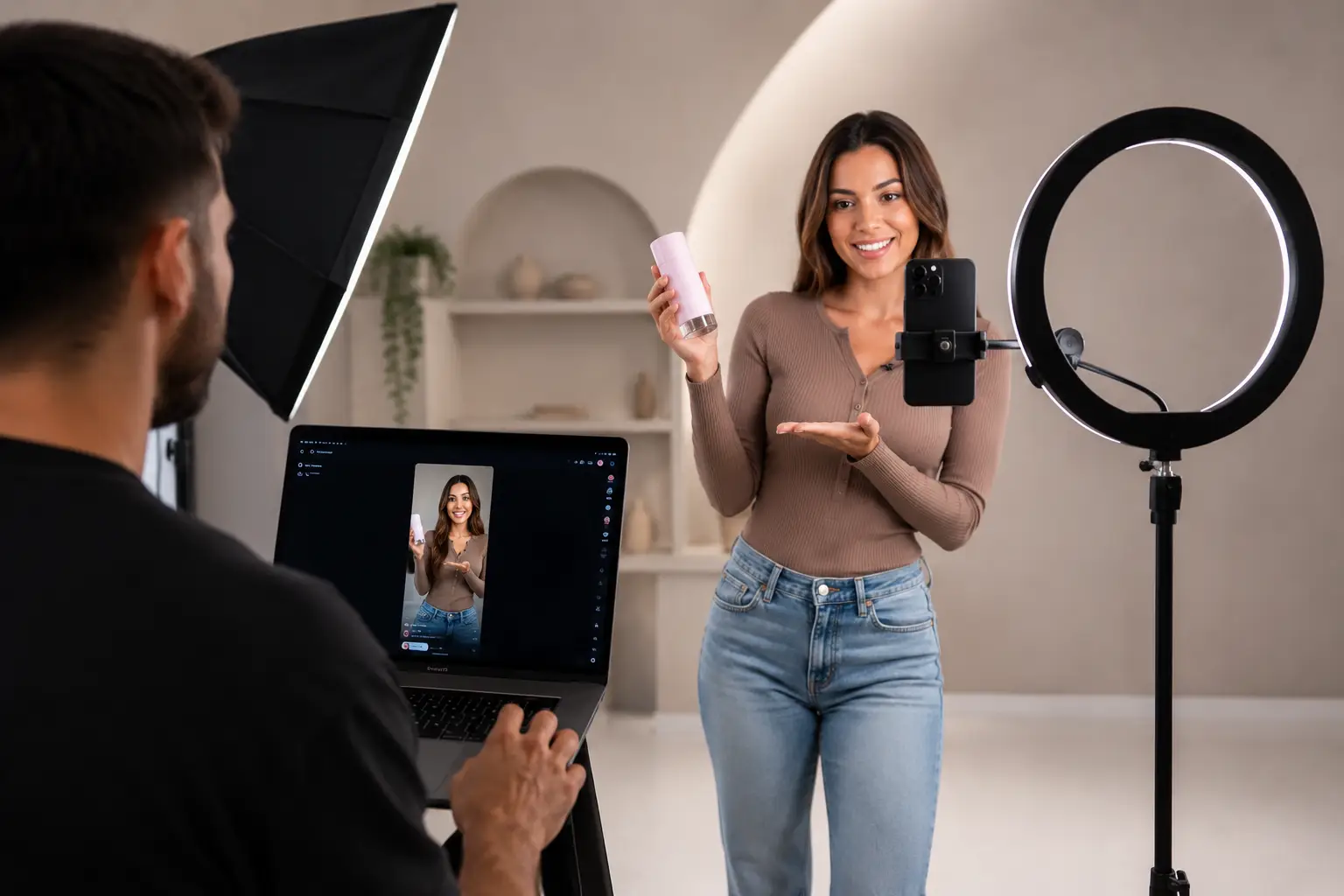
Most e-commerce brands lose money on Meta ads before the campaign even launches, not after. The budget gets burned on a video shot the wrong way: horizontal instead of vertical, an 8-second hook that takes 4 seconds too long to land, or a cut that ignores what Facebook and Instagram actually reward in the algorithm. By the time the ad account shows the results, the production cost is already spent.
Video ad production for Meta platforms is a different discipline from producing a brand film or a website hero video. Every second, aspect ratio and caption choice affects whether the ad gets watched, skipped, or reported by the algorithm as low quality. Getting the production right before the campaign launches is what separates a profitable ad account from one that burns spend on guesswork.
This guide walks through the exact steps for producing Facebook and Instagram video ads for an e-commerce brand in 2026, from account setup through testing, along with what a production partner like AD.JUST Video Production does differently when building social media video promotional campaigns for DTC and e-commerce clients.
1. Set Up Your Ad Infrastructure Before You Shoot Anything
You need a Meta Business Account, an Instagram Business or Creator profile connected to it and Ads Manager access before a single frame gets shot, because the wrong account setup can delay a launch by days. Confirm your Instagram profile is in Professional mode and linked to your Facebook Page inside Meta Business Suite, since Instagram ads run through the same Ads Manager account as your Facebook campaigns.
Skipping this step is the most common reason e-commerce brands delay a launch after the video is already finished. Confirm access and permissions first, then plan production around a launch date you can actually hit.
2. Build Vertical-First, Then Resize
The video should be shot and edited vertically-first at 1080×1920, then resized down to 4:5 and 1:1 for feed placements, not the other way around. Meta’s ad specs call for MP4 or MOV files, H.264 codec, AAC audio at 128 kbps or higher and 1080p resolution as the baseline, with Stories and Reels placements requiring 1080×1920 dimensions and feed placements running at 1080×1350 (4:5).
Shooting horizontally first and cropping down to vertical after the fact cuts off the parts of the frame that mattered most, usually the product itself. AD.JUST Video Production’s social media video production team builds every Meta and Instagram ad vertically-first from the first shot, then adapts the same footage into square and feed-ratio cuts during editing so nothing gets cropped out after the fact.
3. Keep It Short and Frontload the Hook
The strongest direct-response length for Meta video ads is 10 to 15 seconds, long enough to show the product doing its job and ask for the click, short enough that most viewers watch to the end. Facebook technically allows video up to 241 minutes and Instagram up to 60 minutes. Still, the 15-to-60-second range delivers the strongest engagement for paid placements and anything past that window is built for organic or educational content, not a conversion-focused ad.
The first 2 seconds decide whether the rest of the video gets watched. A hook that opens on the product in use, a bold on-screen claim, or an unexpected visual beats a slow logo intro or a brand-first opener every time. AD.JUST Video Production scripts every Meta ad around a hook that lands inside the first 2 seconds, then builds the story around the product’s actual use case instead of a generic brand introduction.
4. Choose the Right Ad Format for Your Goal
Reels-style short-form video drives the strongest organic reach and paid distribution for most e-commerce brands. At the same time, Stories work best for retargeting and urgency offers and carousel or dynamic product ads support catalog-driven campaigns. Match the format to the funnel stage: a cold-audience ad needs a hook-driven Reel, while a retargeting ad to cart abandoners can run shorter and lean harder on urgency and a specific offer.
Running the same static video across every placement wastes budget because each format rewards a different pacing and edit style. A single shoot day can still produce all of them if the production plan accounts for it from the start.
5. Design for Sound Off
Most Meta video ads get watched with the sound muted by default, so the message has to land through on-screen text, captions and visuals alone. Add burned-in captions to every ad, keep primary text inside Meta’s 125-character limit before the “see more” cutoff and keep headlines under 40 characters so the message reads clearly on a small screen.
Meta’s safe-zone guidance also matters here: keep the top 14% and bottom 20% of a 1080×1350 or 1080×1920 asset clear of text and logos, since that space gets covered by the platform’s own UI elements like the profile name, caption and call-to-action button.
6. Build the Creative Around a Product-Solves-Problem Narrative
The ads that convert follow a simple structure: hook, problem, product as the solution and a specific call-to-action, not a highlight reel of brand values. UGC-style visuals consistently outperform polished commercial-style footage for cold-audience Meta ads because they read as a real person’s experience with the product rather than an ad.
AD.JUST Video Production built this exact approach for the bra brand Neiwai, screening more than 100 influencers, hiring 3 creators and delivering 46 UGC video variations built around real product use rather than a single polished spot. That volume of variation matters because Meta’s algorithm rewards fresh creativity and a single video run for too long without a variant starts losing efficiency.
7. Test Systematically, Not Randomly
Run multiple creative variations against the same audience and let the data decide the winner instead of guessing which hook or CTA will perform best. Track hook rate (percentage watching past 3 seconds), hold rate through the full video and click-through rate separately, since a weak hook rate points to a production problem while a weak conversion rate points to a landing page or offer problem.
AD.JUST Video Production’s work with the online prize platform Cases.gg followed this exact model, producing two distinct video concepts built around urgency and high-value prizes so the client could test which creative direction drove stronger paid traffic instead of relying on a single ad.
What a Meta-Focused Production Partner Should Actually Deliver
A video production partner working on Facebook and Instagram ads for an e-commerce brand should be producing for the algorithm and the funnel, not just for the brief. That means vertical-first shooting, a library of hook variations from a single shoot day and edits built around sound-off viewing, not a single polished 30-second commercial repurposed for every placement.
AD.JUST Video Production has built this process for DTC and e-commerce clients running paid Meta and TikTok campaigns out of its Los Angeles studio, including a 16 million-plus view Instagram reel for the smart pool-cleaning brand Aiper and a TikTok and Instagram campaign that helped the pet product brand DIGGS raise more than $300,000 on Kickstarter. The agency delivers single creatives as well as monthly content packages of 30 or more videos for brands that need a constant stream of fresh ad variations.
Frequently Asked Questions
How do I make a Facebook or Instagram video ad for my e-commerce brand?
Set up your Meta Business Account and connect your Instagram Business profile first, then shoot vertical-first at 1080×1920, keep the ad between 10 and 15 seconds for direct response and build the creative around a clear product-solves-problem story with a specific call-to-action.
What is the best length for a Facebook or Instagram video ad?
The strongest length for direct-response Meta ads is 10 to 15 seconds. Facebook technically supports video up to 241 minutes and Instagram up to 60 minutes, but the 15-to-60-second range performs best for paid placements.
What video size should I use for Instagram and Facebook ads?
Build vertical-first at 1080×1920 for Stories and Reels, then resize to 1080×1350 (4:5) for feed placements. Shooting vertical-first prevents the cropping issues that come from converting horizontal footage after the fact.
Do Facebook and Instagram video ads need captions?
Yes. Most viewers watch Meta video ads with the sound off, so burned-in captions are necessary for the message to land. Keep primary text within 125 characters and headlines under 40 characters so the message stays readable on mobile.
How many video variations do I need for a Meta ad campaign?
Most successful e-commerce campaigns run several creative variations at once rather than a single video, since Meta’s algorithm rewards fresh creative and a single ad loses efficiency over time. AD.JUST Video Production has delivered as many as 46 video variations for a single client campaign to support this kind of testing.
Should e-commerce brands use UGC-style or polished commercial video for Meta ads?
UGC-style video generally outperforms polished commercial footage for cold-audience Meta ads because it reads as a real customer experience rather than a traditional advertisement. Many brands use a mix: UGC-style creative for cold traffic and slightly more polished cuts for retargeting.
Facebook and Instagram video ad production for e-commerce brands comes down to a handful of decisions made before the camera rolls: vertical-first shooting, a hook built for the first 2 seconds, captions for sound-off viewing and enough creative variation to keep the algorithm fed. AD.JUST Video Production builds every Meta and Instagram campaign around exactly this process for DTC and e-commerce brands out of its Los Angeles studio.
Ready to produce Facebook and Instagram video ads built for how the algorithm actually works? Get a quote from AD.JUST Video Production or reach out directly at getquote@adjustproduction.com to discuss your next campaign.